A small business website is worth building when people check you before spending, when you want customers beyond your own area, or when your service needs explaining. It can wait when walk ins and Google Maps already fill your day. That is the whole answer. The rest of this post is how to tell which side you are on, what a small business website actually does that a Google profile and Instagram cannot, and what mine did and did not do for me. Most Chennai shops should fix the Google profile first and add the website when the test below says so.
The short version
- Most Chennai shops do not need a website in year one. Google Business Profile, WhatsApp and Instagram do the selling.
- You need one the moment a customer has to trust you with more than a small amount, or has to understand a service before buying.
- A website is the only online asset you own. Google can suspend a profile and Meta can lock an account. Nobody can take your domain.
- One page is enough to start. Who you are, what you do, where, prices, WhatsApp button. That is a small business website.
- Mine is indexed but not ranking for my main keyword yet. It still does a job: people check it before they call, and my blog posts live on it.
- Do not buy a website because someone called you and said you need one. Buy it when the test below says so.
In this post
A bakery owner in Anna Nagar asked me last month whether she needed a website. She had a full counter every evening, a Google profile with forty reviews, and an Instagram that sold out her weekend cakes. My honest answer was no, not yet. She looked surprised, because the three people who called her before me all said yes.
I am a digital marketing freelancer in Chennai and I build websites. Telling someone not to buy one is not great for business. But a small business website is a tool for a specific job, and if the job does not exist yet, the site sits there costing hosting money and doing nothing.
Here’s the thing. For half the businesses that ask me, the answer really is not yet. For the other half, it is overdue. This post is how to tell which one you are.
The honest answer for a Chennai shop
In Chennai, a local customer’s path is usually Google Maps, then WhatsApp, then a visit. The website is often not in that path at all. Someone searching “cake shop near me” taps the profile, sees photos and reviews, calls or messages. Done.
That is why a salon, a bakery, a tailor or a tea shop can run for years on a Google profile alone, and many do. I covered the profile setup in my guide to Google Business Profile optimization in Chennai, and for a walk in shop that guide matters more than this one.
The path changes when the purchase gets bigger or harder to understand. A clinic, an interior designer, a CA, a tuition centre, a wedding photographer. Here the customer does something else between Maps and WhatsApp. They check. They open the website link on the profile to see whether you look real, what you charge, and what you have done before. If there is no link, or the link is a dead Wix page from 2019, a lot of them quietly pick the next result.
So the question is not “does a small business need a website”. It is “do my customers check before they buy”. If yes, you need one.
What a small business website does that a Google profile cannot
Three jobs. Only three, and if none of them apply to you, wait.
It proves you are real. A Google profile is a listing. Anyone can make one in ten minutes, and customers know that. A domain with your name, photos of your actual work, prices, and a page about you is harder to fake and reads as a business that will still exist next year. For any purchase above a few thousand rupees, that check happens before the call.
It explains. A profile has one description field. Instagram has a caption. Neither can explain what a root canal costs and why, or what your interior package includes and what it does not. A small business website can, and a customer who read the explanation arrives as a better lead, which is a problem I know well from my own profile sending calls that go nowhere.
You own it. This one is quiet but it is the biggest. Google suspends profiles, sometimes for no clear reason, and Google’s own page on fixing a suspended profile shows how long that road can be. Instagram accounts get hacked or disabled. Your domain and your site are yours. Every review, post and photo you put on a platform is rented. A website is the one place the rent cannot go up.
There is a fourth job that only matters if you want it: a website is the only place you can write something that ranks. Every blog post I have written lives on mine. Without it, none of this content would exist anywhere I control.
The test: get one now, or wait
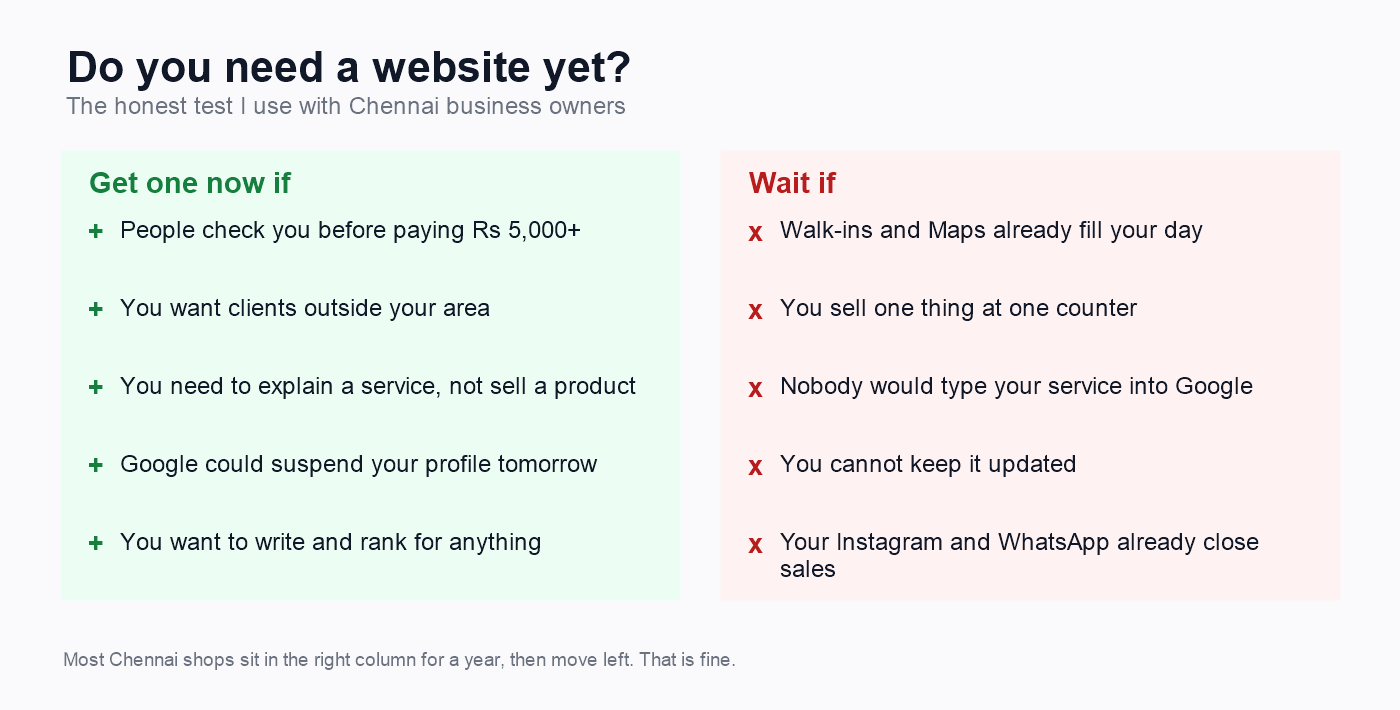
Answer these honestly. Two or more yes answers on the first list and you need a small business website this quarter.
Get one now if:
- Customers spend more than about Rs 5,000 with you at a time, or sign up for something that runs for months.
- You want customers from outside your own neighbourhood, or from outside Chennai.
- Your service needs explaining before someone will pay. Clinics, consultants, designers, coaching, repairs.
- Your Google profile has ever been suspended, or you would be in trouble if it was.
- You want to publish anything: prices, guides, case studies, a blog.
Wait if:
- Walk ins and Maps already fill your day and you are not trying to grow beyond that.
- You sell one thing at one counter and the price is on the board.
- Nobody would type your service into Google. They just come.
- You will not update it. A site with 2023 prices and a closed branch hurts more than no site.
- Instagram and WhatsApp already close your sales and you are happy with the volume.
The bakery owner was five for five on the second list. In a year, when she opens the second branch and starts taking corporate orders, she moves to the first list. That is the normal path and there is no shame in the waiting part.
What my own website did and did not do
I should be honest about mine, because I am telling you what a website does and mine is not a success story yet.
tanishkabhatera.com is a one page site plus this blog. It is indexed. The blog posts are indexed. For my main keyword, “digital marketing freelancer in chennai”, my Google profile ranks in the map pack and my website does not rank on page one, checked in September 2026. So the site has not brought me a client from search. Not one, as of writing.
What it has done. When people call from the Google profile, some have already opened the site, and those calls go differently. They know I am one person, not an agency. They have seen the pricing posts. They ask better questions. The website did the explaining before I picked up.
And every post I write, including this one, is a page I own that can rank over the next year. My profile cannot do that. My Instagram cannot do that.
What went wrong is also useful. I built the site before I had anything to put on it, so for months it was a nice page with no proof. The domain is young. I have six Google reviews and nobody links to the site yet, so Google has no reason to trust it over the older freelancer sites in the city. That is the part most owners miss: a website is the container. It does nothing until you fill it and until other places point to it. I will get to that below.
What a small business website needs, and nothing more
When the test says yes, the next mistake is buying too much. A small business website in Chennai needs one page to start. Five sections on it.
- Who and where, in one line. “Dental clinic in Anna Nagar, open till 9pm, walk ins welcome.” Not a slogan. The thing a customer needs to know in three seconds.
- What you do, with prices or ranges. Prices are the section everyone skips and the one customers come for. If you cannot list a price, list a starting point.
- Proof. Real photos of real work. Your Google reviews pulled in. Before and after where it applies. No stock photos of smiling models, everyone knows.
- Trust details. Your name, your face if you are the business, address, registrations if your field has them, years open if you have them.
- One way to contact you. A WhatsApp button that opens a chat with a prefilled message. Not a contact form nobody checks. I wrote about the WhatsApp side in my post on using WhatsApp Business for marketing.
That is the site. It should load fast on a phone, because that is where every Chennai customer will open it, and it should have your Google profile linking to it and linking back. Add pages later, when there is something to add.
Cost is its own topic and I keep it separate, because a small business website can be Rs 8,000 or Rs 80,000 in this city and the difference is rarely the design [verify]. Do not let anyone quote you before you have done the test above.
Mistakes that waste the money
These are the ones I see on almost every site a Chennai owner shows me.
Buying because someone called. The agencies that cold call shops selling websites are selling websites, not results. If the test said wait, wait.
No prices. “Contact us for a quote” on every service. The customer contacts the next site instead.
Ten pages, nothing on them. Home, About, Services, Gallery, Testimonials, Blog, Careers, Contact. Each with two lines. One full page beats ten empty ones every time.
The site and the profile disagree. Different phone number, different hours, an old address. Google notices, and so does the customer who turns up at the wrong branch.
Nobody can edit it. The developer built it, left, and now changing the price of a haircut needs a phone call and Rs 2,000. Insist on a site you can update yourself, or a written arrangement for who does it.
Built, then forgotten. A small business website with a 2023 festival offer on the home page tells customers you do not look at your own business. Once a month, ten minutes, check it.
A website nobody links to is a brochure
This is the part I got wrong and the part nobody selling you a website will mention, because it is not their job.
Google ranks a site based partly on who else points to it. A brand new domain with no links is invisible for a while no matter how good the pages are, and Google’s own SEO starter guide says as much about links and reputation. Mine is proof. So the website is step one, and step two is giving Google reasons to trust it.
Link it from your Google profile. Put it on JustDial, Sulekha and the other directories your customers use, with the same name, number and address everywhere. Add it to your Instagram bio and your WhatsApp Business profile. If you are in a trade association or a local business group, get listed. Answer a question on Quora properly and mention your site only where it is genuinely the answer.
And get reviews, because Google reads them for the site and the profile together. The weekly habit I use for Google reviews is the cheapest thing on this list and the one I am behind on myself.
None of this is complicated. It is just the half of the job that happens after the site goes live, and the half almost nobody does.
What to do next
- Run the test. Count your yes answers on each list. Be honest about the “will not update it” one.
- If it says wait: fix your Google profile, get to twenty reviews, and come back in six months.
- If it says now: write the five sections on paper first. Who, what with prices, proof, trust, WhatsApp. If you cannot fill them, you are not ready to pay someone to.
- Buy the domain in your own name and your own account. Never let a developer own it.
- Get one page built, link it from your profile and directories, and ask your next five reviewers to mention the service and the area.
I build one page sites for small businesses in Chennai and I am happy to run the test with you for free before either of us talks about a quote. Get in touch if you want that.
So no, not every small business needs a website. But every one that grows past its own street eventually does.
Questions I get asked about a small business website
Does a small business need a website if it has a Google Business Profile?
Not always. A walk in shop can run on the profile alone. You need a website when customers check you before spending, when the service needs explaining, or when you want customers outside your area. The profile brings the call. The website makes the caller trust you.
Is a Google Business Profile enough for a small business in Chennai?
For a bakery, salon, or tailor with local walk ins, usually yes for the first year or two. For clinics, consultants, designers, and anything customers research first, no. And the profile can be suspended at any time, which a website cannot.
What should a small business website have?
One page with five sections: who and where in one line, services with prices, real photos and reviews, trust details like your name and address, and a WhatsApp button. Add more pages only when there is something to put on them.
Can I use Instagram instead of a website?
For selling products to local followers, yes, many Chennai shops do. Instagram cannot explain a service in detail, cannot rank on Google, and can be disabled without warning. Keep Instagram for reach and add a website when trust or explanation becomes part of the sale.
How much does a small business website cost in Chennai?
Anywhere from about Rs 8,000 for a simple one page site to Rs 80,000 and above for something custom [verify]. The right number depends on the test above, not on what the first agency quotes. Domain and hosting run a few thousand rupees a year on top.
Will a website bring me customers on its own?
No. A new site with no links and no reviews is invisible on Google for months. Mine is indexed and still not ranking for my main keyword. The site needs your profile, directories, and reviews pointing at it, and it needs content people search for.
Should I build it myself or hire someone?
If you can write the five sections and have a free evening, a builder like WordPress or a simple one page tool is fine to start. Hire someone when you want it fast, when you need it to rank, or when you know you will not finish it yourself. Either way, own the domain.