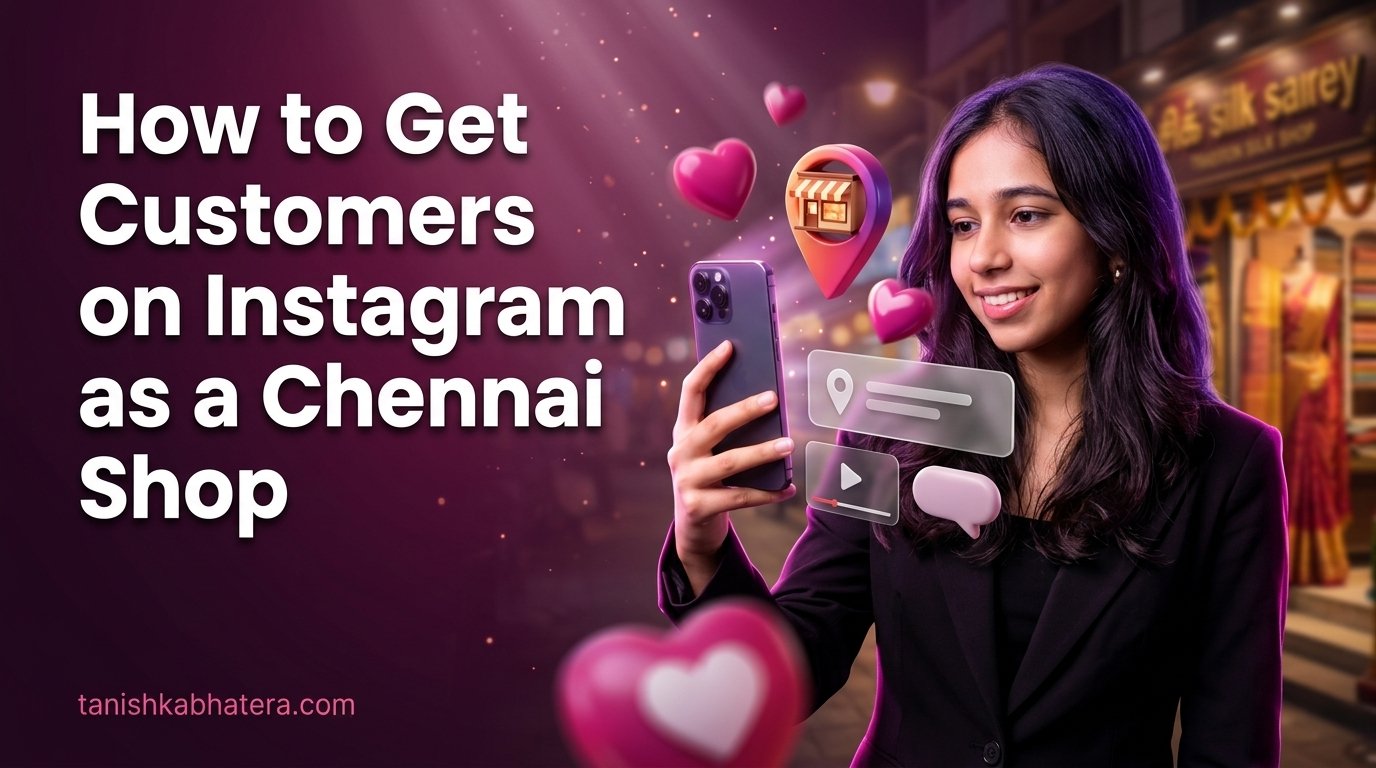
Getting customers on Instagram as a local business means being found by people within a few kilometres, not collecting followers from everywhere. Tag your neighbourhood on every Reel, say the area out loud in the video, get customers to tag your location so you appear on Instagram’s Map, and make the next step a WhatsApp message rather than a DM. Followers are the wrong scoreboard.
The short version
- A Chennai shop needs two thousand followers from Anna Nagar more than twenty thousand from nowhere in particular.
- Instagram’s Map feature arrived in India in late 2025, and it shows businesses that customers have tagged at a location [verify]. Most local shops do not know it exists.
- Tag the specific area, not the city. Instagram’s local discovery favours “Velachery” over “Chennai”.
- Reels under 30 seconds with the neighbourhood spoken aloud and written on screen reach far more nearby people than a polished photo.
- Chennai customers do not buy in DMs. They WhatsApp. Put the link in your bio and the button on your profile.
- Geo tagged posts get around 2.8 times the engagement of untagged ones [verify], which is the single cheapest change on this list.
In this post
A boutique owner in Adyar showed me her Instagram with eleven thousand followers and asked why it brought her almost no customers. We scrolled her followers together. Most were from Delhi, Dubai, and Dhaka, collected from giveaways and follow for follow days. Beautiful numbers, empty shop. As a digital marketing freelancer in Chennai I have had that exact conversation more times than any other about Instagram, so this guide is about getting customers on Instagram who can actually walk in.
Customers on Instagram versus followers on Instagram
For a local business, the only Instagram number that matters is how many nearby people see you this week. A salon in T Nagar cannot serve a follower in Kolkata, so every follower from outside Chennai is a vanity figure that quietly hurts you, because Instagram shows your posts to the audience you already have, and if that audience is far away, the algorithm learns to keep it far away.
Here is the reframe. Two thousand followers who live within five kilometres will fill a boutique. Twenty thousand from everywhere will not. So stop measuring the total and start measuring reach in your own area, which the insights tab shows you under top locations.
Everything below is built on that one idea: get customers on Instagram by being seen by the people who can reach you before dinner.
Set the profile up for a local shop
Switch to a business account first, which is free and unlocks insights, a contact button, and location on your profile. Instagram’s own getting started guide walks through the switch in a few taps, and every step toward customers on Instagram starts from that account type.
Name field, not username. Your username is your handle. The name field is searchable, so make it “Priya Boutique, Anna Nagar” rather than just “Priya Boutique”. People search the area.
Bio in one breath. What you sell, where you are, how to reach you. “Handloom sarees and blouses. Anna Nagar, near Tower Park. WhatsApp to order.” Three lines, no hashtags, no quotes about dreams.
Address and contact button. Add your address so the profile links to a location, and set the contact button to WhatsApp, which is where Chennai customers actually want to talk.
Highlights as a shop window. Prices, new stock, directions, reviews. A customer landing on your profile should get the answers to their first four questions without messaging you.
Adding a location to a post takes three seconds, and geo tagged posts get roughly 2.8 times the engagement of posts without one [verify]. Yet most Chennai shop accounts I audit tag nothing at all.
The tag is how Instagram decides who nearby should see the post. Without it, your Reel about new Kanchipuram silks competes with the whole country. With “Anna Nagar” on it, it competes with a neighbourhood.
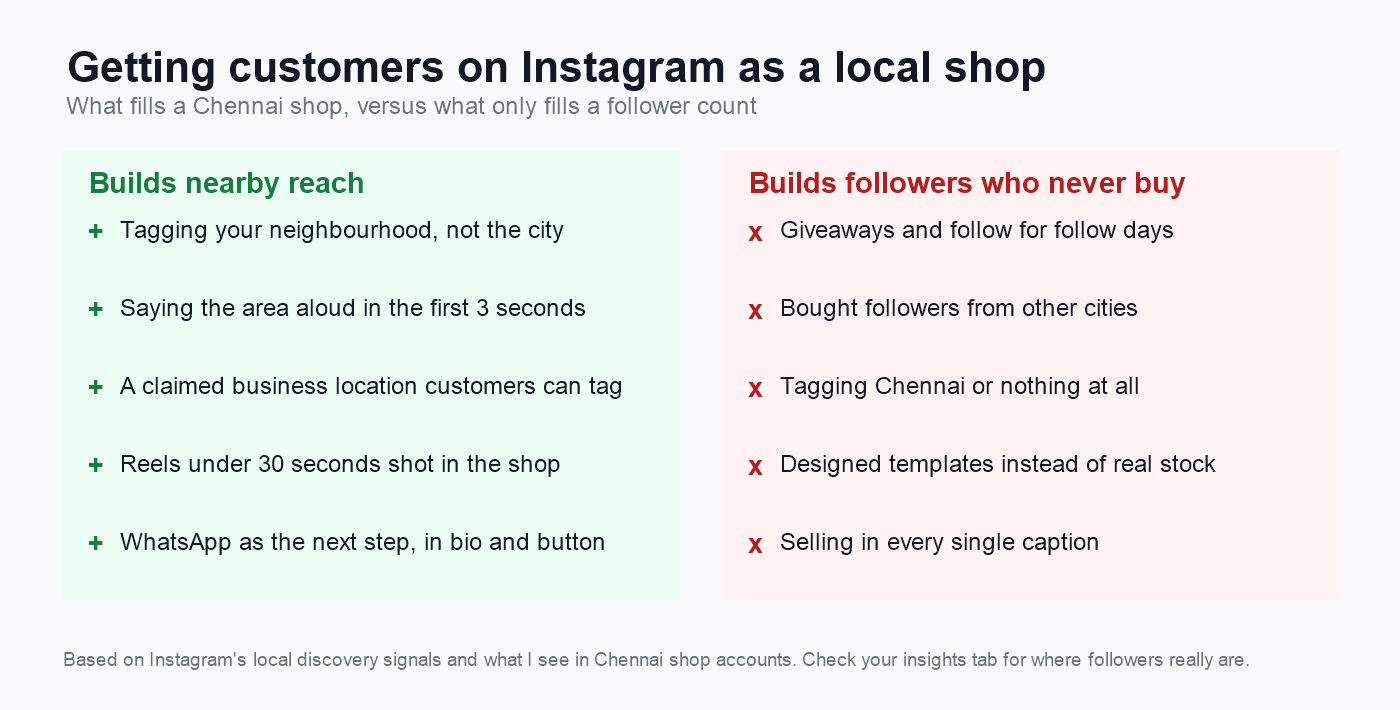
Two rules. Tag the specific area, not the city. Instagram’s local discovery favours specificity, so “Velachery” beats “Chennai” every time [verify]. And create your own business location if it does not exist yet, which you do by checking in on Facebook first, since Instagram pulls its places from there. A shop with its own location tag gets every customer photo tagged to it, and that is where the next section starts.
Instagram’s Map: the newest way to be found nearby
Instagram rolled out its Map feature in India in late 2025, as Business Standard reported at launch [verify], and for a local shop it may be the most useful thing the app has added in years, because almost nobody is using it yet. For getting customers on Instagram who live nearby, it is a shortcut most competitors have not noticed.
The Map lets people see posts, Reels, and stories tagged at specific places around them. If your business has a registered location and customers tag it, you appear on the Map to people browsing what is nearby [verify]. Think of it as Google Maps, but showing what people actually photographed at your shop instead of what you wrote in your description.
Three things put you on it. Have your own location tag, which the previous section covers. Tag it yourself on every post. And ask customers to tag it, which is the part with real power, because a customer’s photo at your location is exactly the kind of independent mention that both Instagram and, increasingly, AI search treat as trust.
Make it easy to ask. A small sign at the counter or the mirror: “Tag us, we repost.” Reposting a customer’s photo to your story costs you nothing and is the reason the next customer tags you too. This is off page marketing happening on Instagram: other people mentioning you, in public, at your address, without you paying for it.
Reels that reach your own neighbourhood
Reels are the cheapest way a local business gets discovered by people who have never heard of it, and the version that works for a Chennai shop is nothing like the version influencers make.
Say the area out loud and write it on screen. Instagram reads spoken audio and on screen text as discovery signals for video, so “new stock just in at our Velachery shop” said in the first three seconds, with the area as a text overlay, does more than any hashtag [verify].
Keep it under 30 seconds. Shorter Reels get watched to the end more often, and full watches are what earn reach [verify]. Show the thing, say where you are, stop.
Use the shop as the set. A phone video of sarees being unfolded on your counter beats a designed template every time, because it looks like your shop rather than an advertisement. Slightly shaky is fine. Real is the point.
Three to eight hashtags, mostly local. Reels already get broad distribution, so fewer targeted tags outperform thirty generic ones [verify]. Neighbourhood tags like the area plus your category have low volume and very high relevance, which is exactly the trade you want.
What to post when you have no time
A shop owner does not have a content team. So here is a week that takes under an hour, built from things that are already happening in front of you.
- Monday: what is new. Fresh stock, a new service, a new dish. Fifteen seconds, price in the caption.
- Wednesday: the work. A finished bridal look, a cake being boxed, a repair done. People buy the result.
- Friday: the place and the people. Your counter, your staff, your street. This is what makes strangers feel they already know the shop before walking in.
- Every day: one story. A customer repost, a stock photo, a “we are open till nine today”. Stories keep you at the top of the feed for people who saved you.
Every one of those gets your location tag, the area said aloud when it is a video, and a price when there is one. That rhythm, kept for three months, does more for getting customers on Instagram than any single viral attempt.
Post in the language your customers speak
A quiet advantage for a Chennai shop chasing customers on Instagram: most competitors post only in English, while a large share of local buyers scroll in Tamil.
You do not need to choose. Say the line in Tamil in the Reel and put the English on screen, or the other way round. A caption that opens in Tamil and closes with the price and “WhatsApp to order” in English reaches both audiences and reads as a real neighbourhood shop rather than a brand template. Tamil comments answered in Tamil also tell the algorithm, and the next viewer, that this account belongs to the area.
The same goes for festival timing. Content about Pongal, Aadi sales, or Diwali stock lands with a Chennai audience in a way generic “festive collection” posts never do, and the local tag plus the local language is a combination almost no boutique around you is using on purpose.
From Reel to WhatsApp, the Chennai way
The last step is where most attempts at customers on Instagram leak. A customer watches the Reel, wants the saree, and cannot see how to buy it. In Chennai the answer is almost always WhatsApp, not a DM and not a website checkout.
So make WhatsApp the obvious next step everywhere. The contact button on the profile. A WhatsApp link in the bio. “WhatsApp to order” in the caption of anything with a price. A reply template in your DMs that moves the conversation to WhatsApp in one tap, because DMs get buried and WhatsApp gets answered.
Once they are on WhatsApp you are in territory I covered in my guide to using WhatsApp Business for marketing: catalogue, quick replies, and the one rule about getting your number saved.
And do not let Instagram replace the channel that brings more walk ins than any other. Someone searching “boutique near me” on Google never opens Instagram. Your Google Business Profile and your Instagram should carry the same name, address, hours and photos, and each should point at the other.
Mistakes that waste a shop’s Instagram
Giveaways and follow for follow. They bring followers, not customers on Instagram, the Delhi and Dubai followers from the Adyar story. Numbers up, reach in Chennai down, because the algorithm now thinks your audience is elsewhere.
Tagging Chennai instead of your area. The city tag puts you against every business in town. The neighbourhood tag puts you against four.
Buying followers. Instagram removes them in waves, and while they last they teach the algorithm your audience is a bot farm in another country.
Designed graphics instead of the shop. Canva templates announcing “New Arrivals” get scrolled past. A ten second phone clip of the actual arrivals gets stopped on.
Posting daily for two weeks, then nothing for two months. Instagram rewards consistency over intensity. Three modest Reels a week for a year beats a burst.
Selling in the caption of every post. Nine out of ten posts should be worth watching even if the viewer never buys. The tenth can sell, and it will, because people are still there.
What to do next
- Open your insights today and look at where your followers actually are. If most are outside Chennai, that is your real problem, and every fix here addresses it.
- Create or claim your business location, add the area to your name field, and set the contact button to WhatsApp.
- Film one Reel this week under 30 seconds, say your area in the first three seconds, tag it, and put a price in the caption.
If you want someone to look at why an account with real followers brings no real customers, get in touch and send me the handle. The insights tab usually answers it in five minutes.
Questions I get asked
How do I get customers on Instagram for a small local business?
Be found by nearby people rather than by everyone. Tag your specific neighbourhood on every post, say the area aloud in Reels, claim your business location so customers can tag it and you appear on Instagram’s Map, and make WhatsApp the next step. Measure reach in your area, not total followers.
How many followers does a local business need to get customers on Instagram?
Far fewer than most owners think, as long as they are local. Around two thousand followers within a few kilometres will keep a boutique or salon busy. Twenty thousand from other cities will not, and they actively hurt reach because Instagram keeps showing your posts to the audience it already has.
Should I tag Chennai or my neighbourhood on Instagram posts?
Your neighbourhood. Instagram’s local discovery favours specific places over city names [verify], so “Anna Nagar” puts you in front of people nearby while “Chennai” puts you against every business in the city. Tag the area, and create your own business location so posts can be tagged to your shop directly.
What is Instagram’s Map feature and does it help businesses?
It is a map showing posts, Reels, and stories tagged at places near the viewer, and it launched in India in late 2025 [verify]. A business with a registered location that customers tag appears on it. For a local shop it is a free way to be discovered by people browsing what is around them, and very few Chennai businesses use it yet.
Do Reels work for a small shop, or only for influencers?
They work better for a shop, because the shop already has the thing people want to see, and Reels are the fastest route to customers on Instagram who have never heard of you. A ten second phone clip of new stock, tagged to your area, with the neighbourhood spoken aloud, reaches nearby people cheaply. Keep it under 30 seconds and show the real shop rather than a designed graphic.
How often should a local business post on Instagram?
Three Reels a week plus a story most days is enough, and consistency matters more than volume. That rhythm takes under an hour a week when the content is simply what is happening in the shop. A burst of daily posts followed by silence does worse than steady modest posting.
Should customers message me on Instagram or WhatsApp?
WhatsApp, for a Chennai business. DMs get buried and half of them go to a request folder nobody checks. Set the profile contact button to WhatsApp, put the link in your bio, and move any DM conversation across in one message. Orders and appointments close far more reliably there.
Can I run a local business on Instagram without a Google Business Profile?
You can, but you would be ignoring the channel that brings the most walk ins. People searching “near me” on Google never open Instagram. Keep both, with the same name, address, and hours, and let each point at the other. Instagram brings people who did not know they wanted you. Google brings the ones already looking.
About the author
Tanishka Bhatera is a freelance digital marketing specialist in Anna Nagar, Chennai. She works one to one with small local businesses on websites, SEO, Google Business Profile, social media and ads, and spends a lot of her Instagram time explaining why follower counts are the wrong thing to chase. Read more about Tanishka.