
Getting more Google reviews comes down to one habit: ask three happy customers a week on WhatsApp, remind two who said yes but forgot, and reply to every review that arrives. That is fifteen minutes a week. At that pace a Chennai business goes from single digits past fifty Google reviews within six months, honestly and inside Google’s rules.
The short version
- Google reviews are among the heaviest signals for both Maps ranking and AI recommendations, ahead of almost everything you can buy.
- The ask works best at the happy moment, in person, followed by a WhatsApp message with the direct link.
- Steady beats big: three to five Google reviews a week for months outranks fifty collected in a weekend, which the filter often eats anyway.
- Since April 2026, review kiosks at the counter and asking customers to name staff members are against policy [verify].
- Paying, discounting, or gifting for reviews has always been banned, and so is collecting only from happy customers through a filter form.
- Replying is half the game. The reply is read by the next customer and by the ranking systems, in the language the review was written in.
In this post
Every audit I do as a digital marketing freelancer in Chennai finds the same thing: good work, happy customers, and a review count stuck in single digits. Not because customers refuse. Because nobody asks, or the ask comes three days too late in a message that is easy to ignore. This post is the fix, with the exact words, the weekly system, and the rules that changed this year.
Why Google reviews decide who gets the call
Reviews do three jobs at once, which is why they beat almost any other marketing effort per rupee spent.
They rank you. In the Whitespark survey of local ranking factors I covered in my Google Business Profile guide, your rating and your review count both sit in the top ten for the Maps pack.
They feed the machines. When ChatGPT or an AI Overview picks businesses to recommend, review count, rating, and freshness are among the heaviest inputs, something I saw first hand when I tested my own AI visibility and lost to competitors with a hundred more reviews.
And they convince the human. Before calling, people read two or three recent Google reviews and the owner’s replies. A profile where the newest review is eight months old whispers that the business might be too.
One more thing worth knowing: fresh matters as much as many. Twenty reviews with three from this month beats eighty that all stopped last year.
The rules that changed this year
Google tightened review collection in April 2026, and two habits common in Chennai shops became violations [verify].
Review kiosks are out. The tablet at the billing counter where customers type a review before leaving is now named in policy, because reviews written on one device at one location get filtered and can flag the profile.
Naming staff in the ask is out too. “Please mention Priya in your review” style requests are against the new rules, so contests between staff for name mentions have to go [verify].
Two older rules still catch businesses daily. You cannot offer anything for a review, no discount, no free dessert, no lucky draw, and you cannot filter, meaning a form that sends happy customers to Google and unhappy ones to a private inbox. Google’s review content policy spells both out. Ask everyone, reward no one.
Also new since late 2025: reviewers can post under a nickname instead of their full name [verify]. Expect more anonymous looking Google reviews, and treat them exactly like named ones.
The ask: exact words that get a yes
The ask works when it is personal, immediate, and one tap away from done. Three parts.
Say it in person at the happy moment. The bride saw the mirror and smiled. The customer said “super” at the billing counter. That exact minute, one sentence: “It would really help my small business if you could share that on Google. I will WhatsApp you the link.”
Send the link within the hour. Get your direct review link from your Business Profile dashboard, the share button under “Ask for reviews”. Google explains the link in its own get reviews help page, and asking this way is fully allowed. Then a message like this:
“Thank you for coming in today. If you have one minute, a Google review helps a small business like ours more than any advertisement: [your link]. Tamil or English, both are perfect.”
That last line matters in Chennai. Many customers hesitate because they think a review must be in polished English. Telling them Tamil is welcome removes the hesitation, and Tamil reviews help you show up for Tamil searches too.
Make it one tap. The link must open straight into the star box. Never say “search us on Google and leave a review”, because every extra step loses half the people who meant to do it.
Put the link where asking happens by itself
The personal ask brings the best Google reviews, but a few quiet placements collect the customers you never got to ask.
A QR code the customer scans on their own phone. Print it small on the bill, on a thank you card in the bag, or on a neat frame near the exit. The difference from the banned kiosk is the device: the customer scans and writes on their own phone, in their own time, which keeps it personal and inside the rules. Skip the tablet you hand over. Keep the printed code.
The bottom line of your invoice. One printed sentence: “Happy with our work? A Google review means a lot to a small business.” People read invoices more carefully than posters.
Your WhatsApp business greeting. If you use a business account, add the review link to the away message or the order confirmation you already send. It rides along with messages you were sending anyway.
Your Instagram bio and booking confirmations. One line, same link, zero extra effort per customer.
None of these replace the personal ask, and none of them reward anyone. They just make sure the door is always open, so the customer who loved the work at 9 pm on a Sunday can walk through it without waiting for your message.
The 3 2 all week: fifteen minutes, every week
The 3 2 all week is the system I set up for clients, and it fits in a lunch break every Monday.
- Ask 3. Pick the three happiest customers from the past week and send each a personal WhatsApp ask. Personal means their name and what they came for, not a broadcast blast.
- Remind 2. Two people who said “sure” last week and forgot. One gentle line: “No pressure at all, sharing the link again in case it slipped.” One reminder maximum, ever.
- Reply to all. Every new review gets a reply before you close the app, in the language it was written in.
The arithmetic is the motivating part. Three asks a week with a normal yes rate lands around eight to ten new Google reviews a month. Keep it up for six months and a profile sitting at six reviews crosses fifty, which changes how every search result and AI answer treats you.
Picture one ordinary month of it. Week one, a bridal client, a regular, and a first timer get personal messages, and two post. Week two, same routine, plus a reminder lands one more. By month end there are eight or nine fresh Google reviews, each with a reply under it, and the profile looks alive to anyone comparing you against a competitor whose last review is from January.
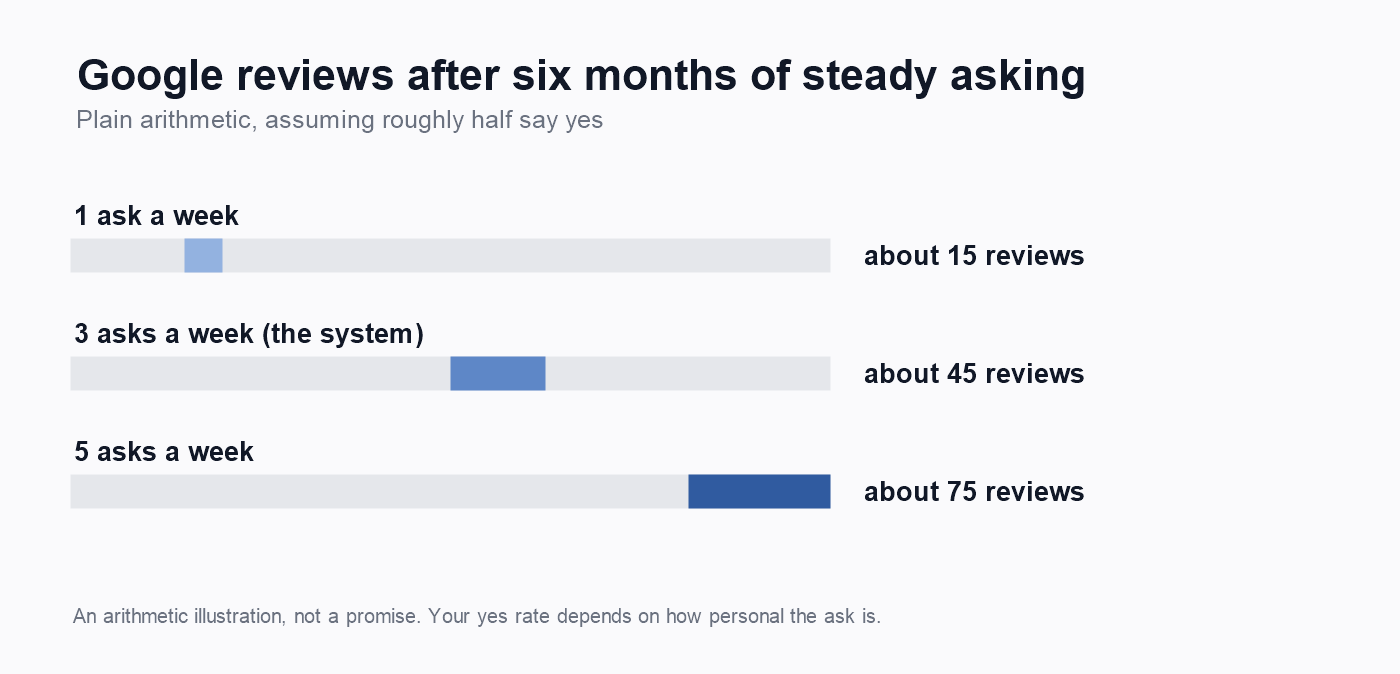
Why steady matters so much: bursts look bought. Google’s filter watches velocity, and fifty reviews in a weekend from one shop triggers it even when every review is real. The filter keeps them invisible, and nobody tells you.
Replying so the next customer books
Write every reply for the stranger reading it next month, not for the reviewer.
For good reviews, two sentences with their name and the service: “Thank you Divya, doing your bridal trial was a joy. See you for the big day.” Never paste the same thank you under ten reviews, because the reader notices in seconds and the systems notice too.
For a bad review, one apology, one fact, one offer, zero arguments: “I am sorry the wait was that long on Saturday. We were one stylist short that day, which is fixed now. Please call me directly next visit and I will make sure it goes right.” The next customer reads that and books anyway, because the reply showed an owner who handles problems.
The three star review with no text deserves a reply too: “Thank you for visiting. If something kept this from being five stars, I would honestly like to hear it, my number is on the profile.” Half the time the customer upgrades the rating after the conversation, and the other half you learn something worth fixing.
Reply in the customer’s language. A Tamil review deserves a Tamil reply, and mixed Tamil English is completely fine because that is how Chennai actually talks.
Bad and fake reviews: what actually works
A genuine bad review is handled by the reply pattern above, and one or two of them actually help, since a wall of perfect fives reads as arranged.
A fake one, wrong person, competitor mischief, or someone you never served, gets two actions. Report it from the profile dashboard under the review’s three dot menu, and reply calmly for the public record: “We have no record of serving you, and we take that seriously. Please contact us so we can check.” Removal takes days to weeks and succeeds only when the review clearly breaks policy, so the public reply is your real protection meanwhile [verify].
What never works: replying angrily, or organising friends to counter attack with instant five stars. Both make the profile look worse to the filter and to readers.
What never to do, even when a competitor does
Buying reviews. Sellers use aged accounts and spread postings, and it still gets caught, because the accounts review the same paying businesses across cities. Filtered reviews, and in repeat cases a profile suspension, cost more than the shortcut saved.
Family and staff accounts. Ten reviews from the same shop WiFi connect themselves in ways you cannot see.
Discount for a review. The customer tells one friend, the friend expects it, and one screenshot in a WhatsApp group is now evidence of a policy violation.
The filter form. “Rate us first, then we decide where to send you” is called review gating and is explicitly banned.
Copying a competitor’s shortcut. That profile with 90 reviews in two months might be enjoying it today and gone next quarter. You are building something that has to last years.
Where I am with my own reviews
I practise this in public. My profile had six Google reviews when I wrote about losing the AI Overview spot to better reviewed competitors, and the 3 2 all week is exactly what I am running on my own business now.
I am not going to fake urgency about it. The count grows by a few every week, the replies go out in the language they arrive in, and you are welcome to check my profile any time to see whether I follow my own advice.
What to do next
- Open your Business Profile today and copy your direct review link from “Ask for reviews”.
- Send it to the three happiest customers you served this week, with their name and one personal line.
- Put “3 2 all” in your calendar for every Monday and do nothing fancier than that for three months.
If your profile has a stuck count, a fake review problem, or replies in a mess, get in touch and I will look at it with you.
Questions I get asked about Google reviews
How do I get more Google reviews fast?
Honestly, you do not want fast, you want steady, because bursts trigger the filter. The reliable route is asking three happy customers a week personally on WhatsApp with the direct link. That compounds to fifty plus Google reviews within six months, all real, all visible, none filtered.
Can I offer a discount for a Google review?
No. Google’s review policies ban money, discounts, gifts, and contest entries in exchange for reviews, whatever the star rating. If it is discovered, the reviews get removed and the profile gets flagged. Spend the same generosity on service worth reviewing, then just ask.
Is it okay to ask customers for reviews at all?
Yes, asking is completely allowed and Google provides the share link for exactly that. What is banned is rewarding the review, filtering who you ask by happiness, collecting on a kiosk at your counter, or telling customers what to write. A plain personal ask breaks no rule.
Why did my Google reviews disappear?
Usually the spam filter, which removes reviews it finds suspicious: several from one device or network, a sudden burst, or reviewer accounts with a pattern. Sometimes the reviewer deleted it. There is no appeal for filtered reviews, which is the strongest argument for slow and real collection.
How do I remove a fake Google review?
Report it from your profile dashboard through the review’s menu, then post a calm factual reply for everyone who reads it meanwhile. Removal happens only when the review clearly violates policy and can take days to weeks [verify]. There is no paid shortcut, and services promising guaranteed removal are guessing with your money.
Should I reply to every single review?
Yes. The reply is read by the next customer deciding whether to call, and profiles where the owner responds look alive to both people and ranking systems. Two sentences with the person’s name and the service is enough. Reply to the bad ones most carefully of all.
Do Tamil reviews help or should I ask for English?
Ask for either, and say so in your message. Tamil reviews read as genuine to Chennai customers, help you appear for Tamil language searches, and remove the hesitation people feel about writing polished English. Reply to Tamil in Tamil. The worst option is a customer who writes nothing because English felt like a test.
How many Google reviews do I need to rank?
There is no magic number, because it is relative to your area and category. Check the top three profiles for your main search and beat their pace, not their total. In many Chennai neighbourhood categories, thirty fresh reviews with steady replies already puts you ahead of profiles sitting on bigger but older counts.
About the author
Tanishka Bhatera is a freelance digital marketing specialist in Anna Nagar, Chennai. She works one to one with small local businesses on website design, SEO, Google Business Profile, social media, and paid ads, and runs every system she recommends on her own business first. Read more about Tanishka.