Getting more patients for a Chennai clinic works differently from marketing any other business, because Indian medical ethics rules limit what a doctor may advertise. What does work is allowed and free: a complete Google Business Profile, neighbourhood specific pages, educational content, and reviews you make easy rather than ask for. Most clinics I audit are missing all four.
The short version
- Indian doctors cannot advertise like shops. Soliciting patients, promising outcomes, using testimonials, and calling yourself “best” are all restricted [verify].
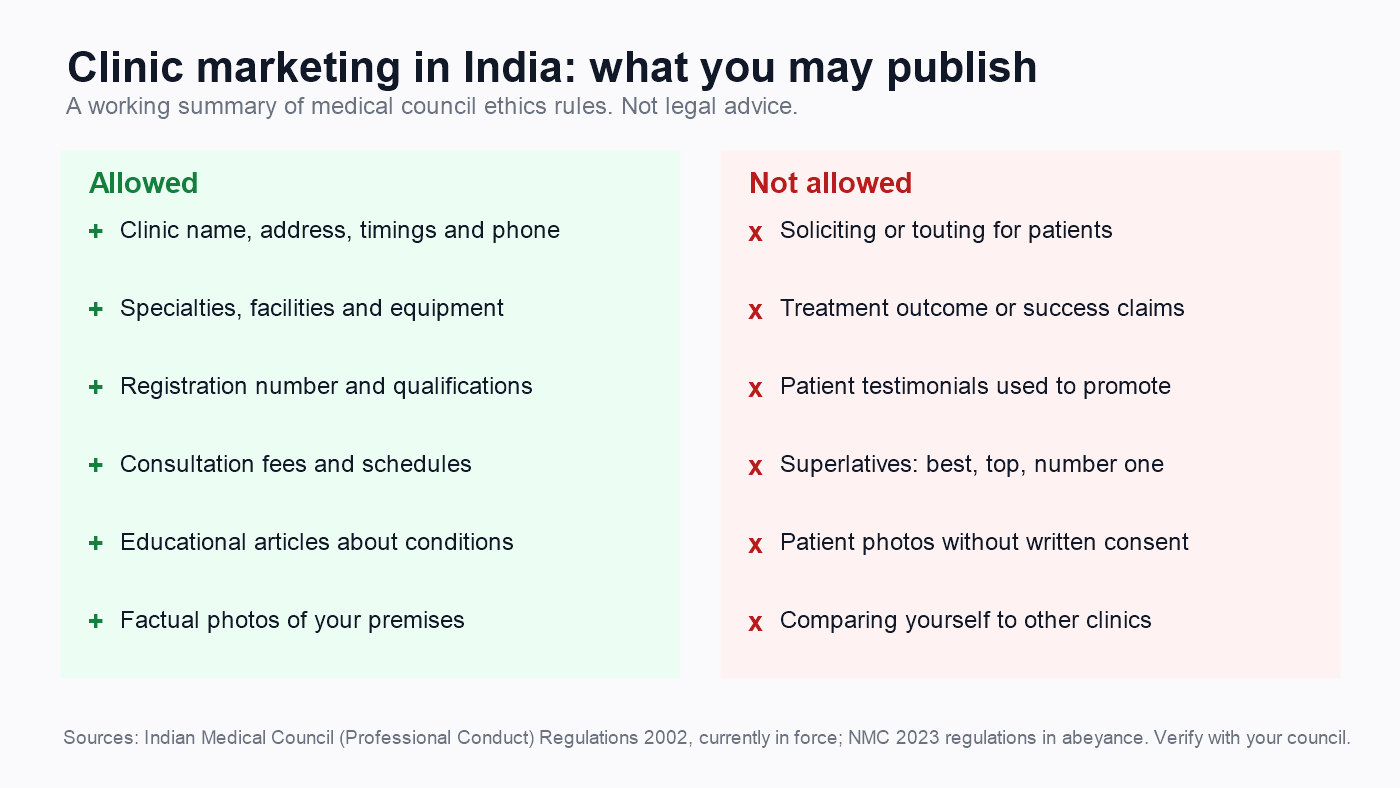
- Factual information is allowed: clinic name, specialties, timings, registration number, facilities, and fees [verify].
- Educational content is allowed, and it is the strongest lever you have. If it helps a patient regardless of which clinic they pick, it is education, not advertising [verify].
- Patients search by neighbourhood, not by city, so “dentist in Anna Nagar” matters far more than “dentist in Chennai”.
- Your Google Business Profile brings more patients than any website change, and costs nothing.
- I audited six Chennai clinic websites for this article. All six used restricted superlatives, five made outcome claims, and only one showed a registration number.
- Check anything you plan to publish with your own council or a medical lawyer, because these rules change and enforcement varies.
In this post
A physiotherapist in Velachery once asked me to run ads promising pain relief in three sessions. I had to tell him no, and not for marketing reasons. That claim could put his registration at risk. Most marketing advice written for clinics ignores this completely, which is why I wrote this one as a digital marketing freelancer in Chennai who has had that awkward conversation more than once.
The rule that changes everything for Indian clinics
Doctors in India work under medical council ethics rules that restrict advertising, and breaking them risks your registration rather than merely your budget.
The current position is worth knowing precisely. The National Medical Commission published new Professional Conduct Regulations in 2023, then placed them in abeyance, so the older Indian Medical Council regulations from 2002 are what apply today [verify]. Dental clinics sit under Dental Council of India rules as well [verify].
What the rules restrict, in plain words [verify]:
- Soliciting patients, meaning content whose purpose is to bring people to you rather than to inform them
- Claims about treatment outcomes, including success rates and cure promises
- Patient testimonials used as promotion
- Superlatives such as best, top, number one, or leading
- Using patient photographs or case details without explicit written consent
Read that list against most clinic websites in Chennai and you will find problems on the home page. I know, because I checked, and the next section shows exactly what I found.
I am a marketer, not a lawyer, so treat this article as a starting point. Before you publish a campaign, run it past your own council or a medical lawyer. That single check costs far less than a complaint.
I checked six Chennai clinic websites. Every one had a problem
Rather than guess how common this is, I audited real sites. On 14 September 2026 I opened the homepages of six Chennai clinics, five dental and one physiotherapy, across Anna Nagar, Velachery and nearby areas, and read them against the restricted list above.
Every single one used a superlative. Five of the six made some kind of treatment outcome claim. Five displayed patient testimonials. Meanwhile only one published a registration number, half showed their timings, and not a single one published consultation fees.
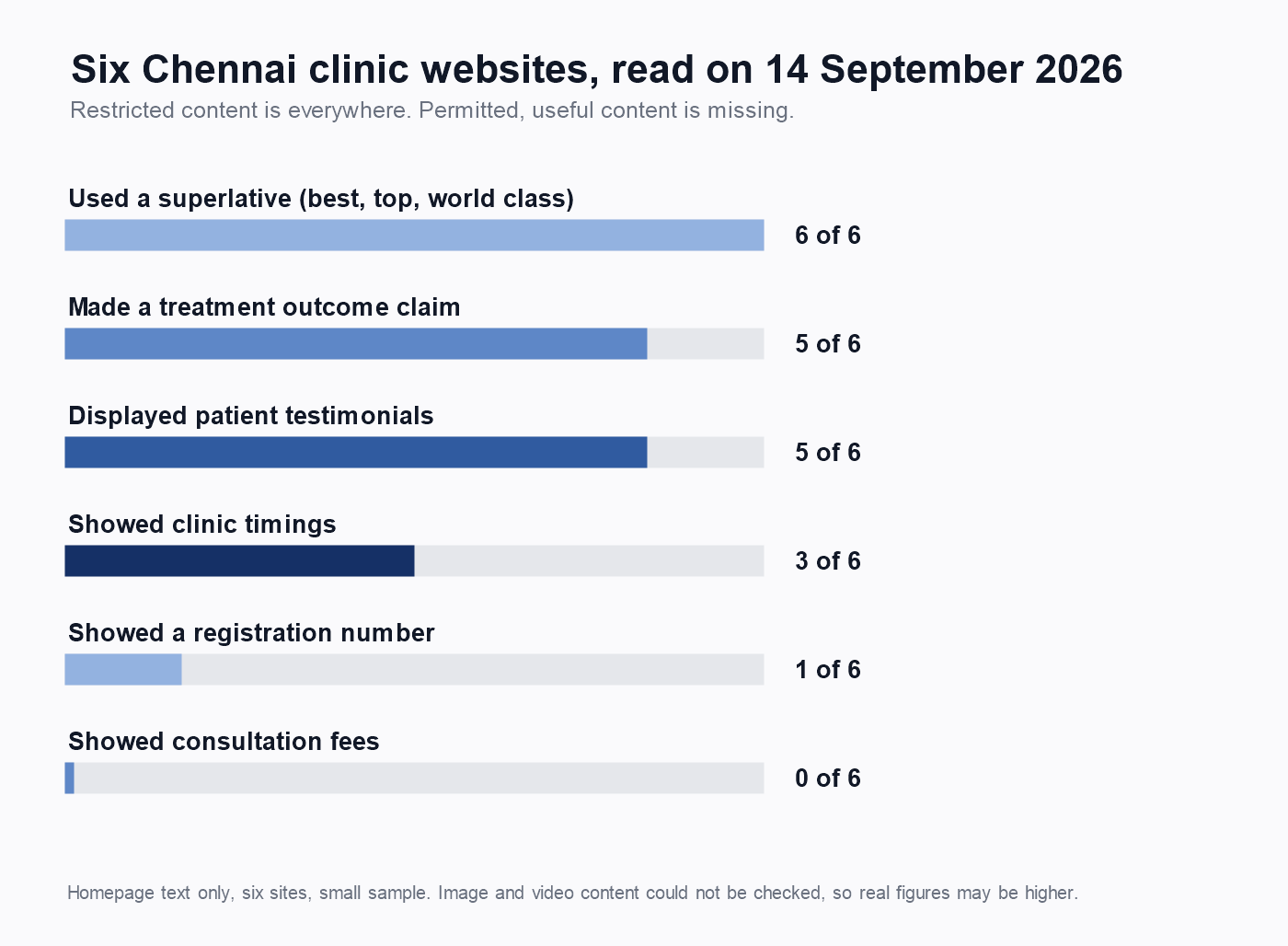
The pattern is the thing worth noticing. These clinics are doing the restricted things thoroughly and skipping the permitted things almost entirely. The risky content is everywhere. The safe, genuinely useful content that patients actually want, timings and fees and clear qualifications, is mostly absent. That is a strange trade, because the missing half is the half that brings more patients.
Some examples of what I found, quoted without naming anyone, because the point is the pattern rather than the clinic:
- A page whose title, headings, and web address all contained the word best, three times on one page
- “Pain free restoration of damaged or infected teeth”, a direct outcome promise
- A clinic advertising “100% 5-Star Ratings” alongside patient reviews tagged with named conditions and treating doctors
- A published reply from a clinic confirming a patient’s recovery timeline in public, which touches confidentiality as well as outcome claims
- One testimonial that thanked a completely different practice by name, left in place from a copied website template
That last one tells you what is really happening here. Most of these clinics are not cynically breaking rules. They bought a website template, often written for American or British practices where the rules differ, and never read the copy against Indian regulations. The violations arrived with the theme.
Two honest caveats about my method. Six sites is a small sample, so treat this as a pattern worth checking rather than a statistic about Chennai. And I could only read text, so claims baked into images or video testimonials were invisible to me, which means the real numbers are probably worse rather than better.
Now open your own website and read the first screen against that restricted list. If you find something, you are in the majority, and it takes ten minutes to fix. Removing a risky claim and adding your timings in its place is the cheapest step toward more patients you will take this month.
What you are actually allowed to do
Plenty, and it happens to be exactly the work that brings more patients anyway. Factual information about your practice is permitted, and so is genuine education [verify]. That is the quiet good news in these rules: the compliant route and the effective route are the same route.
The test I use with clinic clients is simple, and it comes straight from compliance guidance [verify]. Ask whether your content helps a patient no matter which clinic they eventually choose. An article explaining what causes knee pain helps everyone, so it is education. A page saying your knee treatment is the most effective in Chennai only helps you, so it is advertising.
Hold every piece of content against that question before it goes live. It settles most doubts in seconds.
Your Google Business Profile: the biggest free lever
If you do only one thing this month, complete your Google Business Profile properly. It is free, it is factual information rather than advertising, and it decides who appears when someone searches for a clinic near them.
Fill in every factual field, all of which Google’s own profile guidelines expect: the exact clinic name on your board, your specialties as categories, consultation timings including the afternoon break most clinics have, phone, website, and your qualifications where the profile allows. Add real photos of the reception, the consulting room, and the building entrance, because patients genuinely worry about whether they will find the place and whether it looks clean.
Two Chennai details matter more than people expect. Mention parking or auto access, because that decides bookings in areas like T Nagar. And set holiday hours for Pongal and Diwali, since a patient who arrives at a closed clinic leaves the review you least want.
The full method is in my guide to Google Business Profile optimization in Chennai. Everything there applies to clinics, with the review section handled more carefully, which I cover below.
Win your neighbourhood, not Chennai
Patients do not search for “dentist in Chennai”. They search for “dentist in Anna Nagar” or “physiotherapy near me” while sitting in traffic two kilometres from you.
That is good news for a solo clinic, because you are not competing with the entire city for more patients. You are competing with the four or five clinics in your neighbourhood, and most of them have neglected their profile.
So make your neighbourhood explicit everywhere it is factual to do so: your address line, your profile, your website title, and one page per main service that mentions the area naturally. A page titled “Root canal treatment in Anna Nagar” with honest information about what the procedure involves, how long it takes, and what it costs is both compliant and exactly what a worried patient is searching for at 11 pm.
If you serve patients who travel from nearby areas, mention those areas once in your description. Do not stuff a list of twenty localities, which reads as spam to Google and to patients.
Educational content that brings patients ethically
Educational content is your strongest and safest route to more patients, because it is permitted and because it answers what people actually type into Google at night. It is also the part almost no Chennai clinic bothers with, which is why the opening is so wide.
Write the questions your patients ask in the consulting room. What causes this pain. Whether this needs surgery. What this procedure feels like. How long recovery takes. Roughly what it costs, which patients search constantly and almost nobody answers honestly.
Keep the writing plain and factual. Explain the condition, the usual options, when someone should see a doctor, and what to expect. Do not claim your results, do not compare yourself to other clinics, and do not end with a sales pitch. A clear line saying appointments can be booked by phone is enough, and it is factual information rather than solicitation.
This does three things at once. It ranks for the long questions no clinic bothers to answer. It answers the patient’s fear before they walk in. And it stays inside the rules, because it would help that patient even if they chose the clinic across the road.
Reviews without crossing the line
Handle this section differently from every other business, and be careful.
Reviews matter enormously for local ranking and for patient trust. But testimonials used as promotion are restricted for doctors [verify], so a clinic cannot run the review campaign a salon runs. The distinction that matters: a patient choosing to write about their experience on Google is their speech, while you scripting, soliciting, or republishing praise as marketing is yours.
What I consider the safe side of that line:
- Make leaving a review easy and passive. A small printed QR code at reception, no pressure, no script, no suggestion of what to write.
- Never offer anything in return, which breaks both Google’s rules and medical ethics.
- Never publish patient reviews as testimonials on your website or social media without explicit written consent, and think hard even then.
- Reply briefly and neutrally: “Thank you for visiting our clinic.” Never confirm a diagnosis, a treatment, or an outcome in a public reply, because that touches patient confidentiality.
- Reply in Tamil when the review is in Tamil.
My general system for getting reviews is in my post on getting more Google reviews. For a clinic, use the passive parts of it and skip the active asking, and confirm your approach with your council before you start.
Competing beside Apollo and Fortis
You will not outrank a large hospital group for broad searches, and you do not need to. Their size is also their weakness.
A big hospital page covers a specialty for the whole city. It cannot tell a patient in Adyar that parking is easy, that the doctor runs evening hours until eight, or that a consultation costs a specific amount. Those specific, local, honest details are exactly what a nervous patient is looking for, and they are the things you can publish freely because they are facts.
So compete on specificity. Neighbourhood, timings, the particular procedure you do most, the questions you answer patiently. A solo clinic that publishes clear evening hours and real consultation fees beats a corporate page for the searches that actually convert.
The easiest source of more patients is the ones you already treated
Most clinics chase strangers while forgetting the people already in their register. Contacting your own patients about their own care is not soliciting, because they are already under your care, which makes this the safest growth channel you have [verify].
Three habits do most of the work.
Recall for what you already recommended. The patient you told to return in six months for a cleaning, a review scan, or a dressing change. A simple WhatsApp reminder on the due date brings a surprising number back, and it is clinical follow up rather than marketing.
Keep it factual and personal: “This is Dr Kumar’s clinic. Your six month dental check is due this week. Reply if you would like an appointment.” No offers, no discounts, no urgency language.
Ask patients where they heard about you. One line at reception, written into the register. After two months you will know whether your patients come from Google, from a neighbour’s recommendation, or from the board outside. Most clinics guess at this and spend money in the wrong place as a result.
Make referral easy without incentivising it. Paying for referrals is restricted and, in the case of fee splitting between doctors, seriously so [verify]. But a patient who wants to recommend you should not have to hunt for your number. A clinic card in the prescription folder, with your name, timings, and phone, does that job quietly.
None of this costs anything, and for an established clinic it usually brings more patients faster than any new content will, because these people already trust you.
What to stop doing today
Calling yourself the best. Look at your website header right now. Words like best, top, and number one are restricted for doctors [verify], and they are the first thing a complaint would cite.
Publishing success percentages. Outcome claims are restricted, and patients distrust them anyway.
Posting patient photos or case studies casually. These need explicit written consent [verify]. A before and after photo shared without it is a serious problem, not a marketing win.
Buying leads from aggregator platforms without reading the terms. Some listing sites write promotional copy in your name that you would never have approved. You remain responsible for what appears under your name.
Ignoring your profile while paying for ads. I see clinics spending on ads with a profile that has no photos and the wrong timings. Fix the free thing first, because it brings more patients per rupee than anything you can buy.
What to do next
- Read your own website header and service pages today and remove every superlative and outcome claim.
- Complete your Google Business Profile: categories, exact timings with breaks, real photos, and holiday hours.
- Write one honest article answering the question patients ask you most often, and publish it with your neighbourhood in the title.
Those three steps bring more patients than any advertising budget you could set this month, and none of them costs anything. If you want someone to audit your clinic’s online presence against these rules before you spend on anything, get in touch. I will tell you what is working, what is missing, and what needs removing.
Questions doctors ask me
Can doctors advertise in India?
Not in the way other businesses can. Medical council ethics rules restrict soliciting patients, outcome claims, testimonials, and superlative language [verify]. Factual information about your clinic and genuine educational content are permitted. Confirm specifics with your own council, since the 2023 NMC regulations were placed in abeyance and the 2002 rules currently apply [verify].
How can I get more patients without breaking ethics rules?
Use the permitted routes, which happen to be the effective ones. Complete your Google Business Profile with factual details, publish educational articles answering real patient questions, make your timings and fees clear, and target your neighbourhood rather than the whole city. None of that solicits, and all of it brings more patients.
Does WhatsApp follow up with my own patients count as advertising?
Contacting your existing patients about their own treatment is clinical follow up, not solicitation [verify]. A recall reminder for a due check up is generally accepted. What changes the character is adding offers, discounts, or promotional language, so keep the message factual and specific to that patient’s care, and confirm your approach with your council.
Can I ask patients for Google reviews?
Be careful here. Reviews themselves are patient speech and valuable, but soliciting testimonials is restricted for doctors [verify]. The safer approach is passive: a small QR code at reception with no script, no incentive, and no suggestion of what to write. Confirm your approach with your council before starting anything systematic.
Should my clinic run Google Ads?
Only after your profile and website are complete, and only with ad copy checked against the ethics rules. Ads for clinics must stay factual, naming the service, area, and timings without outcome promises. Many clinics get more patients from fixing their free profile than from their first advertising budget.
How do I compete with big hospitals in Chennai?
Do not compete on broad city searches. Compete on your neighbourhood and your specific services, where a large hospital page cannot match your detail. Clear evening timings, parking information, honest consultation fees, and patient questions answered plainly will beat a corporate page for the searches that actually lead to appointments.
What should I write about on my clinic website?
Write what patients ask you in the consulting room. What causes the condition, what the options are, what the procedure feels like, how long recovery takes, and what it roughly costs. Use the test that content should help a patient regardless of which clinic they choose [verify]. That keeps it educational rather than promotional.
Can I put patient before and after photos on Instagram?
Only with explicit written consent, and even then think carefully [verify]. Consent must be specific and documented, not a verbal yes during a consultation. Many clinics find illustrative or educational images safer than real patient images, and they carry no confidentiality risk.
How long before clinic marketing brings more patients?
Profile improvements can show within weeks, because local search responds quickly to a complete, accurate listing. Educational content takes three to six months to rank, similar to any other SEO. The clinics that get more patients soonest start with the free profile work while the content builds quietly behind it.
About the author
Tanishka Bhatera is a freelance digital marketing specialist in Anna Nagar, Chennai. She works one to one with small local businesses, including clinics, on websites, SEO, Google Business Profile, and ads, and refuses campaigns that would put a client’s registration at risk. Read more about Tanishka. This article is general marketing guidance, not legal advice.